How to Read Dog Treat Labels and Spot Five Details to Check Before You Buy
A quick first-pass scan for deciding what is clear—and what needs verifying
By Tim Fonseka
If you have ever turned over a bag of dog treats, read the ingredient list, and then returned to one line, you know why learning how to read dog treat labels matters.
The front of the package may say “natural,” “wholesome,” or “made with real chicken.” The ingredient panel gives you the details behind those claims.
That second read does not automatically mean an ingredient is harmful. It means something was not clear enough for you to decide comfortably.
Later, when you reach for a treat, the unfinished question can return:
Was that fine?
That flicker is the cost of the second read.
Here’s how to spot five label details worth checking, so you can understand what you’re giving your dog—and know when to ask for more information.
Three questions to help you read the label
Start with one focused first-pass scan and ask three questions:
Do I recognize the main ingredients?
Do I understand why the less familiar ingredients are included?
Can I decide whether to buy—or whether I need more information?
When any answer is no, pause and verify before buying.
This is not a safety guarantee or a substitute for veterinary advice. These questions show where a label is clear—and where you need more information.
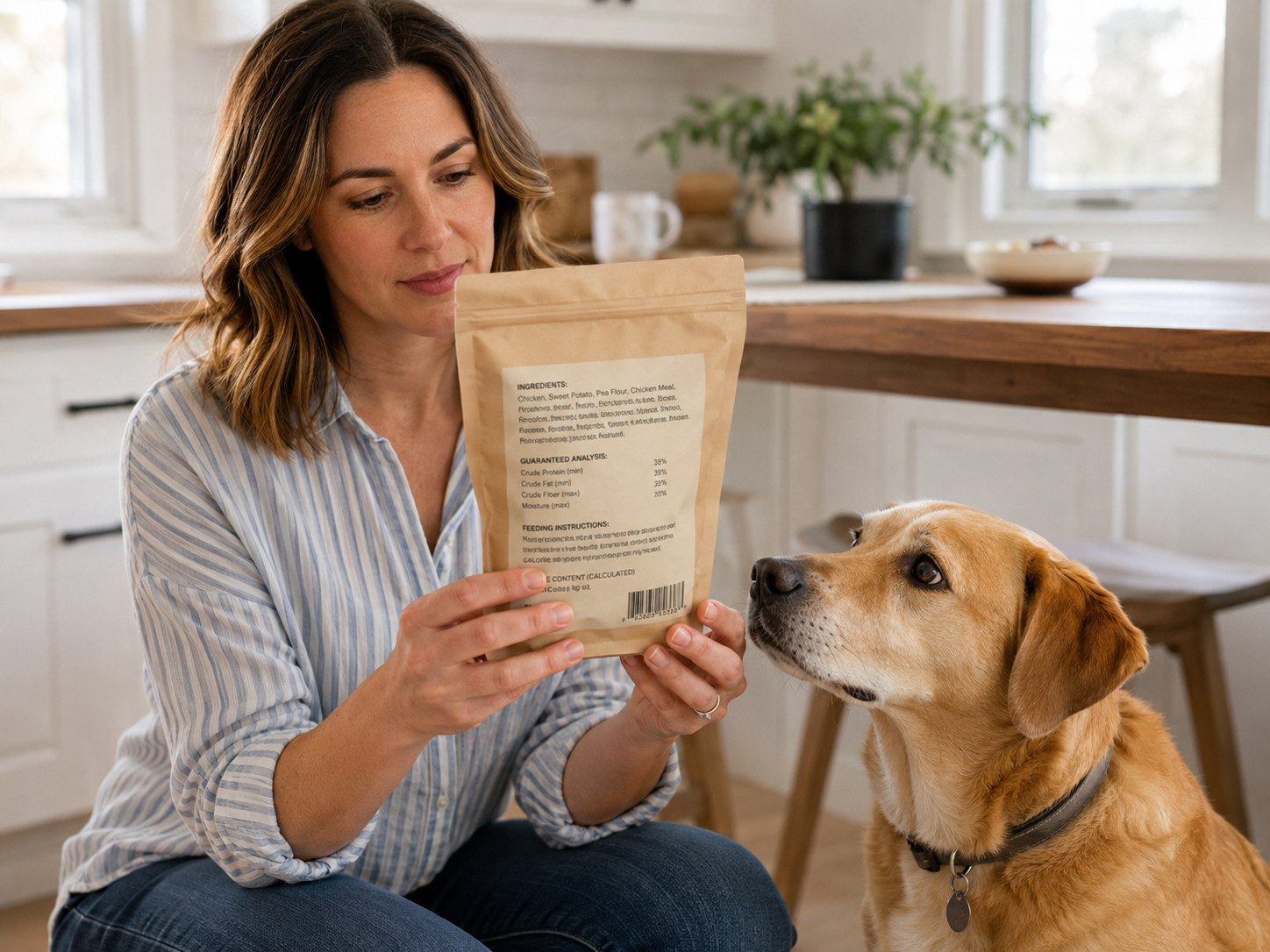
What a U.S. ingredient list can tell you
On U.S. pet food labels, the Food and Drug Administration requires animal food ingredients to be listed by their common or usual names in descending order by weight. The ingredient weighing the most appears first.[1]
The Association of American Feed Control Officials (AAFCO) notes that the list shows ingredient order, not exact amounts.[2]
The first few ingredients deserve attention, but the list alone cannot tell you whether a treat is right for your dog.
Here are five places to apply those questions.
1. An animal source that is not clearly named
Compare “chicken liver” with “animal digest.”
One identifies the animal and part. The other may require research before you know what it describes.
Clarity question: Can I identify the animal source?
When you cannot, check the manufacturer’s website or contact the company—especially if your dog has a food sensitivity.
2. One ingredient appearing in several forms
Corn, corn flour, corn gluten meal, and corn syrup solids are listed separately because each is a distinct ingredient.
That does not automatically make the treat a poor choice. Reading related ingredients together can clarify the formula.
Clarity question: Does the same basic ingredient appear more than once?
3. Added colors
Names such as Red 40, Yellow 5, and Blue 1 are easy to spot. FDA guidance requires certified color additives used in animal food to be declared by their listed or appropriately abbreviated names.[3]
Added color changes how the product looks to the shopper. It does not clarify what is inside.
Clarity question: Are any added colors listed?
4. Broad flavor descriptions
A term such as “natural flavor” or “artificial flavor” gives you less detail than a clearly named flavor source.
Clarity question: Does the label tell me what creates the flavor?
5. Preservatives you do not recognize
Preservatives help maintain freshness. Labels may name BHA or BHT, while some identify mixed tocopherols as a preservative.[4]
Clarity question: Do I understand why this preservative is included?
When you do not, verify the term through a reliable source—or ask your veterinarian.
How the sample panel performs
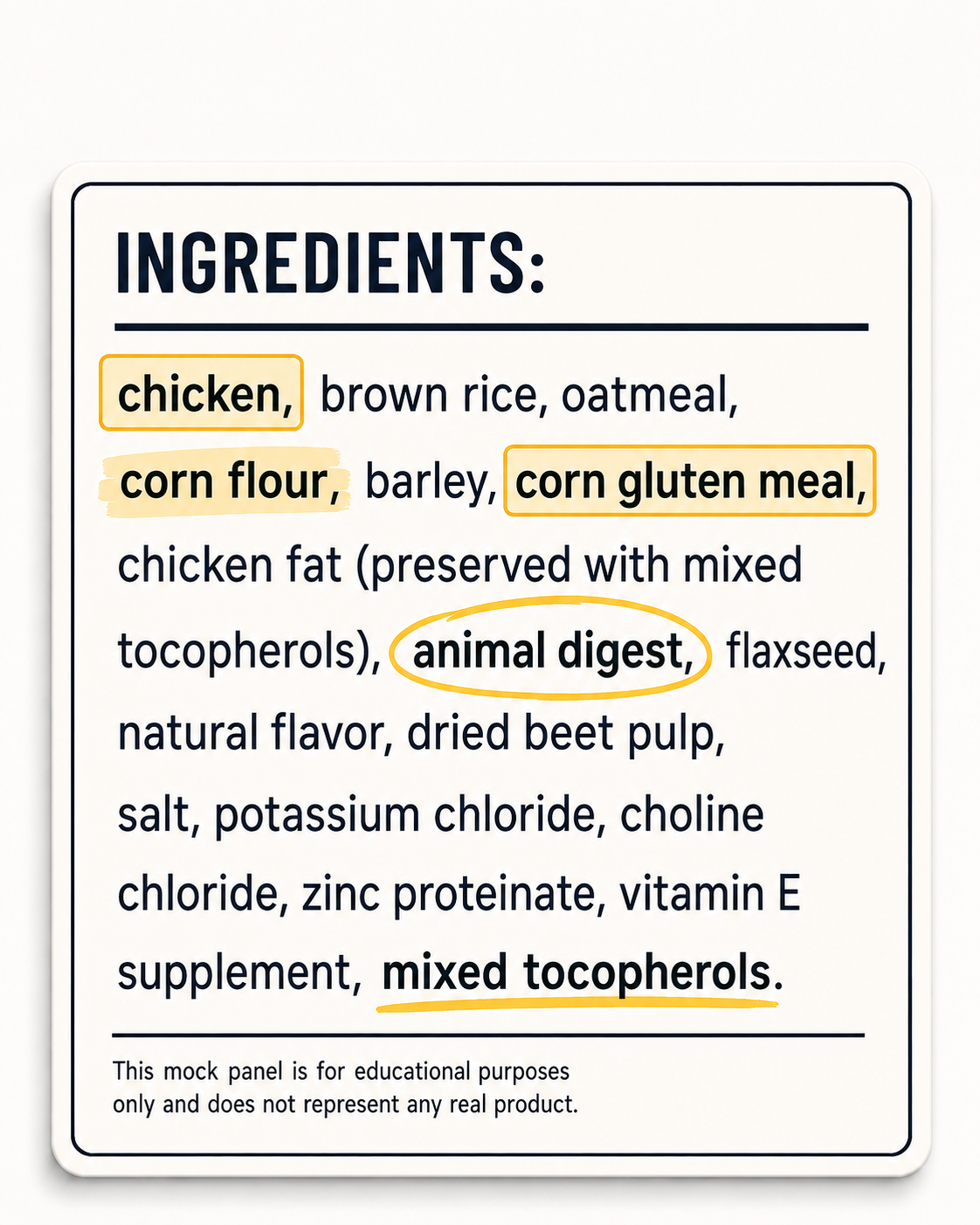
On a first-pass scan, this sample panel may leave questions unanswered. The main ingredients are recognizable, but several terms may need checking before you can make a comfortable decision.
The five checks show why:
Animal source: “Animal digest” does not name the animal.
Repeated forms: “Corn flour” and “corn gluten meal” appear separately.
Added colors: None appear, so the panel passes this check.
Flavor description: “Natural flavor” does not identify its source.
Preservative: “Mixed tocopherols” may need verification when unfamiliar.
Those terms alone do not show that the sample is unsafe or illegal.
If any of those details is unclear to you, pause and verify before buying.
Decision rule: When you cannot identify the main ingredients or explain a term that concerns you, pause before buying.
A clearer label leads to a clearer decision
Learning how to read dog treat labels is about knowing what to notice, what to question, and when to get more information.
Give the panel one focused first-pass scan. Ask the three questions. Then use the five checks wherever an answer is unclear.
You can either make your choice—or know exactly what to verify.
When the label is clear, the mental replay stops.
The decision feels finished.
It is relief.
Want these questions and five label checks in a guide you can keep on your phone?
Request the free guide, How to Choose Dog Treats You Can Trust, so you can compare labels with more confidence instead of wondering what an unfamiliar ingredient means.
Send Me the Free Guide to Read Labels with Confidence
A label cannot determine whether a treat suits every dog. Ask your veterinarian about allergies, medical conditions, or special dietary needs.
Sources
[1] U.S. Food and Drug Administration, “Animal Food Labeling and Pet Food Claims.” Accessed July 23, 2026.
[2] Association of American Feed Control Officials, “Reading Labels.” Accessed July 23, 2026.
[3] U.S. Food and Drug Administration, “CVM GFI #223: Small Entity Compliance Guide Declaring Color Additives in Animal Foods.” Accessed July 23, 2026.
[4] U.S. Food and Drug Administration, “Types of Food Ingredients”; Association of American Feed Control Officials, “Reading Labels.” Accessed July 23, 2026.